Observe. Revise. Ego-less Work. Always.
I've come up with five letters built around four concepts to work better and more creatively every time.
When I first came up with the Oregon farm in 2025, it landed in my brain after months books and papers of managing teams, leadership and business. At that time there was also a fair number of lectures, podcasts and talks on creativity and sprinkled in my short term memory was various systems, processes, rubrics and their derivations.
The way a new kind of movie studio would stand the test of time, was to build it from zero on a foundation of iterative excellence.
But the really compelling part, would be not to raise a billion and do it in the style of Hollywood. Couldn’t anyone with connections, financing and resources do that?
So I came up with a way to work that feels closer to the schedule, budget and workflow of B-movie mogul Roger Corman, but offers real world systems to avoid compromises on quality and preserves artistic integrity.
I believe the ONLY way to make both of those things true simultaneously is to have systems and remove ego from the process at every turn. Because what I’ve determined from a lifetime in this business is that the most most expensive part of any production, is not the cast, crew, IP, post, print, advertising or special effects. It is ego.
I wrote an essay about it, and you can read it here.
So when it comes to building a new kind of studio from the ground up, I believe there needs to be 2 modus operandi that can work together and separately to maximize possitive results, one system is for technical and logistical concerns and operations, and the other for creative work.
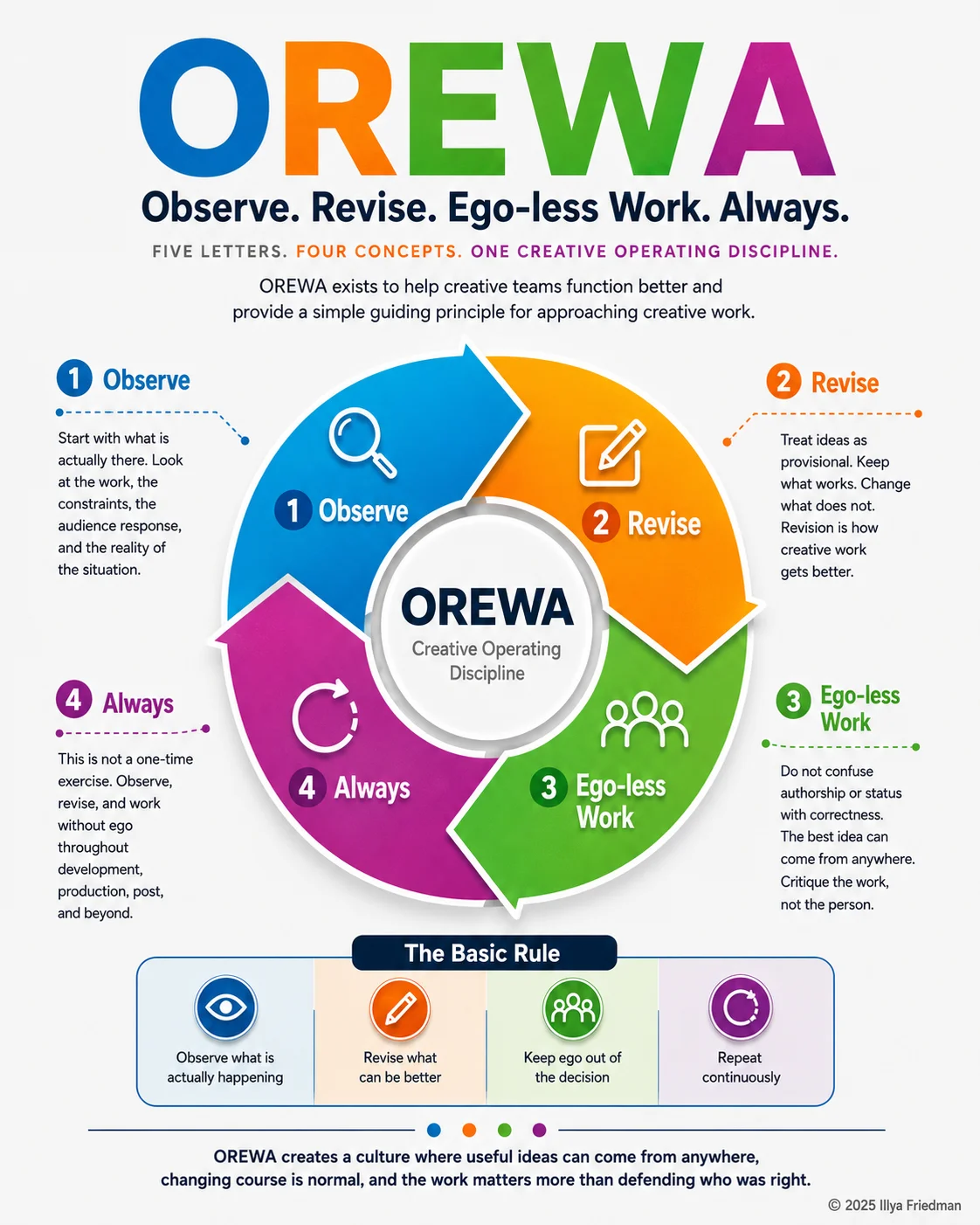
Today, I want to share my system for creative system, and I promise it’s short. I even designed a little infographic for it, and you are welcome to reach out if you have questions, because I want help people to use it for their creative endeavors. It’s called…
OREWA
Observe. Revise. Ego-less Work. Always.
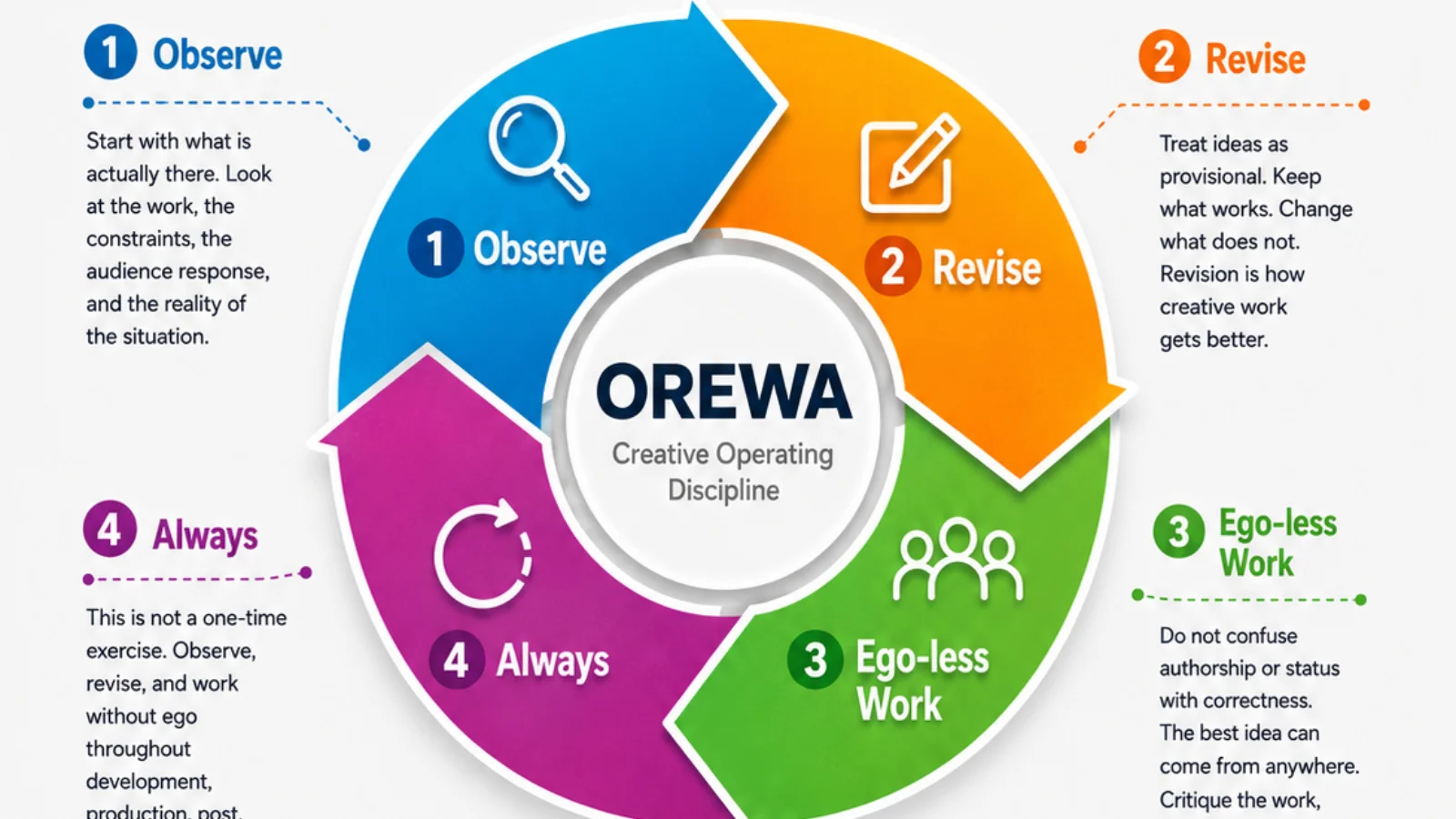
OREWA is just five letters built around four simple concepts. It can and should be used in a way similar to the Pixar Brain Trust, which was really a version of FDR’s brain trust, and it can be used at every step of the process if needed.
The reason this exists is only for two reasons: to help creative teams function better, and to provide a simple guiding principle for how to approach creative work.
Creative work has a peculiar problem: eventually, somebody must decide if it’s good. Money, time and labor will all get commited and so it’s really important that all the people involved actually know what the goal is.
There are tools that can tell us whether something is technically correct. Formulas and spreadsheets can tell us if a goal has been achieved. There are schedules that can tell us whether we are early or late. But there is no instrument to point at a screenplay, a performance, photograph, design, or piece of music that simply tells us whether it is good.
We have to use judgment.
And once more than one person is involved, that judgment must operate inside a group. Because people bring different experience, background, taste, authority, insecurities, ambitions, habits, and assumptions into the room. Sometimes the differences make the work better. Sometimes they make the room worse.
OREWA is a system meant to help create the proper conditions where creative judgment has the best chance of working.
Observe
Look at the work as it is.
Pay attention to what it is doing, how are people in the room responding to it, how about outside the room? Notice where it becomes difficult, where it becomes interesting, and where reality has departed from the original idea.
Real observation comes before explanation. It doesn’t come while multitasking, it can’t come while also being on the phone.
You are going to have to talk about everything you see, and the temptation, particularly when something isn’t working, is to tune out- instead do the opposite. You are not going to have to explain why it should be working. Resist that temptation. Perception is reality, and reality gets a vote. You need to try to understand why it isn’t.
Revise
Once you can see the work clearly and if it can get better, change it.
It’s that simple.
It’s best if you have a good idea how it should change, but it’s often okay just to ackowledge that it doesn’t work and a solution exists somewhere out there.
Creative work is not diminished by revision. It is created through revision.
A screenplay changes because somebody finds a better scene. A performance changes because an actor discovers something on take 3. A shot changes because the location, weather, schedule, or light presents a better answer. The edit changes because two images juxtaposed teaches you something you could not have known beforehand.
The original idea is useful because it gets the work started. It does not earn permanent protection simply by arriving first.
Keep what works. Revise what doesn’t. Omitting is revision.
Ego-less Work
This is the difficult part. Most people have a really hard time with this.
Ego-less does not mean nobody has authority, expertise, taste, or responsibility. Creative work requires those things to be applied appropriately.
Neither authority, nor authorship can or will ever make the idea correct.
A useful observation may come from the anyone. The person responsible for the final decision still has to make it, but good creative leadership requires enough confidence to recognize that the best answer is sometimes somebody else’s.
That also means criticism of the work cannot be treated as criticism of the person who made it.
If defending an idea becomes more important than improving it, the process has stopped being about the work.
Always
OREWA is not something you do once. It is the way the work gets done.
Observe and revise while developing. Observe and revise while preparing. Observe and revise on set. Observe and revise when reality gives you new information. And of course, do it again in the edit, and again when an audience sees the work.
Experience should make this easier, not exempt anyone from it.
The moment somebody becomes too accomplished to reconsider an idea is probably the moment you most need them to reconsider one.
So this system is deliberately simple:
Observe what is actually happening. Revise what can be better. Keep ego out of the work. Do it, always.
OREWA does not promise that every creative decision will be right.
It creates a working culture in which being wrong is cheap, changing course is normal, useful ideas can come from anywhere, and nobody needs to protect yesterday’s answer simply because it was theirs.
Part II Putting OREWA into practice.
Observe - Start by paying attention.
Observe the work as it actually exists, not as it was intended. Also observe the people who are experiencing the creative work (the audience.) Is the result working as intended?
Ask:
- What is working?
- What is not working?
- What are we missing?
- What has changed?
- What does the work need now?
Good judgment begins with accurate observation.
If something isn’t working, do not begin with defense or explanation. Instead understand what is happening.
Revise
Every idea is provisional.
The first answer does not need to be the final answer. When something can be improved, improve it. When new information changes the problem, ask if the solution also needs to change.
Revision is not evidence of failure. It is the normal process by which creative work becomes better.
It will be hard, but do not ever protect an idea because of how much time, money, status, or emotion has already been invested in it. Some people will call this the “sunk cost fallacy.” Professional Poker Player Annie Duke wrote a book about this central theme called Quit: The Power of Knowing When to Walk Away.
Keep what works. Change what does not. Don’t keep pushing forward without making a change for the better.
Ego-less Work
Separate the value of an idea from the status of the person who proposed it. These should never be linked. It seems like they nearly always are.
Despite what you’ve seen during your life. No one person or title owns the best answer to a problem. The people on set share the same language, so when being objective Directors, producers, writers, actors, crew members, executives, assistants, and other specialists should all be able to identify problems and contribute solutions.
Criticism is only of and about the work, it should not be criticism of the person. Don’t take it, or make it personal, ever.
The goal is not to win an argument, mark your territory, receive credit, or prove that you were right. The only goal is to make the work better.
Authority may determine who makes a decision. But it does not determine which solutions are allowed for consideration.
Always
OREWA is not a meeting, workshop, or development-stage exercise. It is a continuous practice from inception to completion. To practice OREWA you must:
Any stage can be observed and revised. As a creative team, your job is to do exactly this.
There is no point at which success makes observation unnecessary or experience makes revision beneath you.
The cycle is:
Observe → Revise → bring Ego-less Work → Repeat until the workd is as close to perfect as it can become.
The basic rule
When a problem appears:
- Look at what is actually happening.
- Say what you see clearly.
- Invite useful disagreement.
- Test the strongest available solution(s).
- Change the work when the evidence supports changing it, including every part.
- Do not confuse authorship, hierarchy, or pride with correctness.
- Repeat for as long as the work can still be improved.
OREWA does not require everyone to agree.
It requires everyone to care more about the quality of the outcome than about being the person who was right.
Are you a convert and want to try this out? Sownload the graphic below to use as a cheat sheet.